
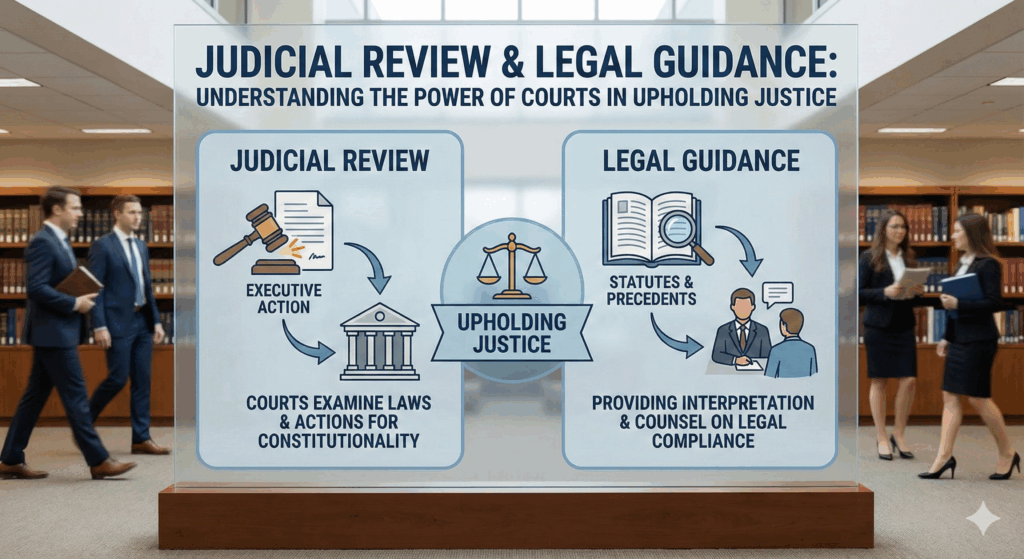
Judicial Review & Legal Guidance: Understanding the Power of Courts in Upholding Justice
In every democratic society, the rule of law stands as the foundation of peace, order, and accountability. One of the strongest pillars supporting this foundation is judicial review—a legal mechanism that allows courts to examine the actions of public authorities and determine whether those actions comply with the constitution and the law. Judicial review does not simply question governmental decisions; it safeguards citizens’ rights, ensures transparency, and upholds justice in society.
This blog explores the meaning, purpose, and process of judicial review, while also offering practical legal guidance for individuals and businesses navigating this crucial area of law.
What Is Judicial Review?
Judicial review is the power of a court to review decisions, actions, or omissions of the government and its agencies. When a public authority exceeds its powers, violates legal procedures, or infringes upon fundamental rights, the judiciary steps in to examine the legality of the decision.
In simpler words:
Judicial review ensures that no authority—no matter how powerful—is above the law.
This principle strengthens the system of checks and balances, preventing misuse of power and protecting individual liberties.
Purpose of Judicial Review
Judicial review serves several essential purposes in a constitutional democracy:
1. Protection of Fundamental Rights
Citizens can challenge state actions that violate their constitutional rights, such as freedom of speech, due process, equality, or property rights.
2. Ensuring Government Accountability
Every public authority must act within the boundaries of law. Judicial review prevents arbitrary decisions and holds officials accountable.
3. Upholding the Rule of Law
It ensures that all actions are grounded in legal authority, creating fairness and transparency within governance.
4. Maintaining Checks and Balances
Judicial review acts as a counterweight to legislative and executive powers, preventing abuse of authority.
Grounds for Judicial Review
Courts typically assess government actions based on three well-established grounds:
1. Illegality
A decision is illegal if:
- the authority acted beyond its legal powers (ultra vires),
- misunderstood the law,
- failed to take mandatory factors into account,
- relied on irrelevant considerations.
Example:
If a licensing authority rejects an application without any statutory reason, the decision may be struck down for illegality.
2. Irrationality
Also known as Wednesbury unreasonableness, this occurs when a decision is so unreasonable that no sensible authority would have made it.
Example:
Imposing a disproportionate penalty for a minor violation may be considered irrational.
3. Procedural Impropriety
This applies when the decision-making process is unfair or violates principles of natural justice, such as:
- not giving a fair hearing,
- bias or conflict of interest,
- not following legally required procedures.
Example:
Issuing a notice without giving the affected party a chance to respond.
Types of Judicial Review Remedies
When a court finds that a public authority acted unlawfully, it may issue one or more of the following remedies:
1. Certiorari
Quashes an unlawful decision made by a public authority.
2. Mandamus
Directs an authority to perform its legal duty.
3. Prohibition
Stops an authority from acting beyond its powers.
4. Habeas Corpus
Protects against unlawful detention.
5. Declaration
Declares the legal position or rights of parties.
6. Injunction
Restrains a party from performing an unlawful action.
These remedies ensure that public bodies remain within their legal boundaries.
The Judicial Review Process: How It Works
While the exact procedure may vary across jurisdictions, the general steps include:
1. Identifying a Public Law Issue
The dispute must involve an act or decision of a public authority, not a private matter.
2. Pre-Action Communication
The applicant sends a legal notice, giving the authority an opportunity to review or correct the decision.
3. Filing the Petition
A judicial review petition is filed in the appropriate court, often accompanied by supporting documents and evidence.
4. Court Permission
Many systems require obtaining formal permission (leave to proceed) to ensure that the claim is arguable.
5. Full Hearing
Both parties present arguments before the judge, who evaluates the legality—not the merits—of the decision.
6. Court Decision
The court may quash the decision, order fresh decision-making, or grant other remedies.
Judicial Review vs. Appeals: Understanding the Difference
Many individuals confuse judicial review with an appeal, but the two are fundamentally different:
Judicial Review
- Focuses on legality of the decision.
- Examines procedure, powers, and fairness.
- Does not reconsider the factual merits.
Appeal
- Reviews the correctness of the decision.
- Can re-evaluate facts and evidence.
- Allows the appellate court to substitute its decision with a new one.
Understanding this distinction helps individuals and businesses choose the right legal path.
Importance of Judicial Review in Modern Governance
In today’s complex world, governments exercise significant control over economic, social, and administrative areas. With increasing governmental power comes the risk of:
- arbitrary decisions,
- unfair regulations,
- misuse of authority.
Judicial review ensures that government actions remain consistent with constitutional norms, promoting accountability and fairness.
For businesses, it acts as a safeguard against:
- unjust taxation,
- unfair license revocations,
- biased regulatory actions.
For individuals, it protects rights related to:
- employment,
- property,
- freedom of expression,
- liberty.
Common Situations Where Judicial Review Is Used
Here are real-world examples where judicial review plays a vital role:
1. Unfair Dismissal or Employment Actions
Employees challenge decisions made by government departments or public employers.
2. Licensing and Regulatory Issues
Businesses often seek judicial review when licenses are unfairly revoked or denied.
3. Immigration Decisions
Judicial review helps ensure fairness in visa refusals or detention orders.
4. Taxation and Financial Regulation
Errors in assessment or unlawful penalties can be challenged.
5. Police or Law Enforcement Excesses
Unlawful detentions, searches, or misuse of power can be subject to review.
Legal Guidance for Individuals and Businesses Considering Judicial Review
Before filing for judicial review, consider the following practical steps:
1. Act Quickly
Most jurisdictions have strict deadlines—often 30 to 90 days. Delays may result in dismissal of the case.
2. Gather Evidence
Maintain records, notices, emails, and any communication showing unfairness or illegality.
3. Identify Public Law Elements
Ensure the issue involves a government authority, not a private contractual dispute.
4. Seek Expert Legal Assistance
Judicial review is complex and technical. A qualified law chamber or legal professional can:
- evaluate the merits,
- identify grounds,
- draft arguments,
- represent you in court.
5. Explore Alternative Solutions
Sometimes, negotiation or internal review processes can resolve the issue without litigation.
Why Judicial Review Matters for the Future
As societies evolve, so do laws and governmental powers. Judicial review remains the ultimate safeguard that ensures fairness, transparency, and accountability. It protects not only individual rights but also strengthens democratic institutions by ensuring that public authorities remain within the boundaries of law.
In an age where regulatory bodies and administrative agencies hold vast powers, judicial review empowers citizens and businesses to challenge injustice and uphold their legal rights.
Conclusion
Judicial review is more than a legal mechanism—it is a guardian of justice, fairness, and the rule of law. Whether you are an individual fighting for your rights or a business protecting your interests, understanding judicial review is essential in today’s legal landscape.
By providing clarity, transparency, and accountability, judicial review ensures that justice prevails, no matter how powerful the authority involved.
If you need assistance in filing for judicial review or understanding your legal rights, consulting a qualified law chamber can be the first step toward achieving justice and resolving complex public law issues.
